The Joys of Ad Placement

Monday, June 6, 2011 0 comments
I am sure that there are insightful things to say about the coverage of Anthony Weiner's sex scandal.

For example, Stephen Colbert and Jon Stewart both raised questions in the last couple of days about the role of comedian vs. journalist when they bemoaned the fact that photos of Weiner's weiner makes for comedic gold but that they are friends with Weiner. They make no secret of the fact that they are both liberal comedians, but I found both comedians willingness to talk about their hestinancy to make fun of this prominent democratic congressman (even as they did make fun of him) interesting, particularly for Stewart who sometimes does journalists' jobs when he looks at what (usually Republican) politicians have said in the past compared to what they are saying now.


But that's not what I want to talk about.

What I want to say is this:

The New York Times' liveblog of Weiner's press conference ran with a particularly apropos ad on the top of the page


Do you think it's too late for Weiner to improve his online reputation? I think so.

A Woman At The Top

Friday, June 3, 2011 0 comments
I really need to go to sleep, but I just wanted to write something quickly about today's announcement that Jill Abramson will replace Bill Keller as the executive editor of the New York Times. 

My heart jumped a little when I read the news this morning. It's a really big deal. Journalism can still feel like an old boys club. I am shocked by the small number of women in the Senate press room every time I walk in there. Journalism will not become gender-balanced over night or even over the next few years, but Abramson's appointment is certainly a step in the right direction, and as a female journalist I can't help but feel elated (even as I wonder about the fallacy that women should automatically root for other women).

Now, the most prominent newspaper in the country will be lead by a woman. Her second in command will be Dean Baquet, the second black man to be managing editor. These are important steps for the slow-moving beast that is the journalism industry.

Abramson, who has served as a D.C. bureau chief for the Times, made clear that she valued contributions to the Times by both men and women, but she also took time to highlight the women.

From the Times:
In her remarks to the staff on Thursday, she took time to acknowledge “my sisters,” naming more than a dozen women at The Times who have helped her along the way, including the company’s chief executive, Janet L. Robinson. 

From the Washington Post: 
Among the bookcases and posters in Jill Abramson’s office at the New York Times is a blown-up black-and-white photo of the newsroom, circa 1895, in which a group of men huddle around a desk occupied by a woman named Mary Taft.


“She looks like the boss,” said Abramson. Not quite — Taft was the paper’s second female reporter. On Thursday, the 57-year-old Abramson was named the first woman to head the Times’ newsroom in its 160-year history. 
A few days ago I was re-reading my post on women in leadership positions in which I wondered if there would ever be a time when successful women did not feel that they had to be judged as female leaders as opposed to leaders, with gender a non-issue.

It's been almost exactly three years since I wrote that post, and I don't think society as a whole is there yet, but a quote in the Washington Post article leaves me hopeful (emphasis mine):
“I wouldn’t say that she was chosen because she’s a woman,” said Baquet, who is the second African American journalist to become managing editor of the Times, “but I still think it’s a big deal. It just so happened that the person best positioned to be executive editor of the New York Times is a woman. . . . I believe other women who aspire to jobs in journalism will see this as a statement about how far this profession has changed.”  

Bonus! This is an excerpt from the obituary of Mary Taft Welch published in the New York Times in December 1944:


The obituary informs readers that Taft, who was hired in 1897 or 1898, "covered news of women's activities" wrote "some art criticism" and "reported many of the early developments in the agitation for women's suffrage." She "won the respect and liking of her male colleagues on this and other newspapers" and retired in 1924.

New Yorker September 24, 2001

New Yorker September 17, 2001
 A while back, I wondered about the usefulness of iPad magazines, and noted that they had the potential to update as needed and never (or less frequently) go out of date. In that post, I noted that the first New Yorker edition to come out after September 11 had nothing to do with the attacks (and may have arrived on news stands on September 10). Because of an inevitable printing lag, the magazine with the all black cover and shadows of the twin towers was the September 24 issue, the second issue after the attacks. It ran with no cartoons.

The September 11 attacks were on a Tuesday, which--along with the print to distribution lag--meant that the New Yorker, which dates its weekly issues with the Monday date had to wait a whole 13 days until its print edition could comment on the attacks.


New Yorker May 2, 2011

Osama bin Laden was killed Sunday evening New York time May 1, 2011. His death was confirmed by President Barack Obama late Sunday night. Of course, the New Yorker issue dated May 2 was not going to comment on the bin Laden's death; almost a full week before he died.  The May 9 magazine, has nothing on bin Laden either; it appears to have arrived on news stands on May 2.

On September 11, 2001, the New Yorker website was less than a year old. Now, the site serves as a supplement to the magazine. Currently, there are at least 45 online items (blog posts and audio included) about Osama bin Laden that have been posted since Obama's speech.

Newsweek  May 6, 2011

In terms of technical feasibility, I understand why all that work is web-only. Unlike the New York Times, it was clearly far too late for the New Yorker to yell "stop the presses".  The New Yorker is not a news magazine; Newsweek's Friday cover, for example, will feature bin Laden (left). But changes in how we read magazines makes the New Yorker lag feel particularly strange.

I currently read the New Yorker on a Kindle. Because it arrives instantly and via the Internet, I am more aware of how behind it is. I have already received the issue dated May 9, and I found myself disoriented when I started reading the first article: "Memorials" by Adam Gopnik. When I saw the title, I expected it to be about Ground Zero, the Pentagon, or something about how we memorialize and celebrate. Instead it is about Civil War memorials in New York City. It's interesting and well written, but seems totally disconnected from the world in which I live.

New Yorker May 9, 2011
The experience of momentary confusion, of a tiny clash of new technology and an 85-year-old stodgy, scrutinized  magazine, brought up this question: should the electronic editions (iPads and e-readers) of magazines be different from the print edition? Should someone have changed the lead article in the magazine that was sent to my Kindle? I already get a modified version of the magazine: there are no columns, no ads,   no illustrations or photographs, and all of the comics are grouped together in one section. Why shouldn't I get a magazine that reflects some of the huge amount of content generated by New Yorker reporters and writers since I received the last issue?

 I am not sure when the issue arrived on my Kindle; it could have happened Sunday night (I've been reading a print book and hadn't checked for a bit). If so, there would not have been time to update the Kindle edition. Still even if they chose to release the Kindle edition slightly after the magazine hits the first news stand,  I'd still get my issue before print subscribers got theirs.

On the one hand, that's a lot of extra work, considering Kindle, Nook, and iPad users (who I think get a magazine much closer to the print issue than Kindle users) likely spend a lot of time on the Internet anyway. On the other hand, shouldn't changes in technology be embraced for what they do best?

As someone who likely will switch  back to the print edition in the near-ish future (it turns out, I feel just as guilty about partially-read issues building up in my digital archives as I do them piling up in my bedroom), I could see print subscribers --who pay more than I do--getting annoyed that they get less content. On the other hand, that extra money allows print subscribers to turn the pages, read in the bath, see color images, share the magazine with friends, tear out comics or covers they love, and--and this is key-- access the digital edition at newyorker.com. What if that edition reflected the extra content? (Or, if that content remained free to access online). Why not acknowledge that a magazine that arrives  over a 3G network while I sleep could and should be a dynamic product?
Photo by Getty Images photographer Peter Macdiarmid, published on The Guardian's website

The kid on the left is clearly as fed up with the wedding as I am.

The bridesmaid, who is Prince William's 3-year-old god daughter, Grace van Custem, looks grumpy or confused in a lot of photos. I would grumpy and confused too if I were a 3-year-old kid in the midst of pomp, circumstance, and an international media circus.
I emerge from my half-a-year silence to talk about women. And writing. Surely, there was no shock in that.

The Pulitzer, by my own  count, is one of the more gender-balanced literary prized out there. By my count, 29 out of 86 Pulitzer awarded for fiction or novel (as the award category was once called) were awarded to women. That's 33 percent.Its not great, but its better than the other book awards.

The National Book Award has been awarded 68 times, 15 times to women (22 percent)  Twelve out of the 43 books awarded the Man Booker Prize were women (27 percent).  Twelve out of 107 Nobel Laureates in literature are women. That's 11 percent.

So, of all the prizes to win as a female fiction writer, the Pulitzer is the one where gender should be the smallest, issue. But, news questions are, to some extent, predictable, so a short Wall Street Journal interview with Jennifer Egan, who won the prize for her book Visit From the Goon Squad ended with this:

Over the past year, there’s been a debate about female and male writers and how they come off in the press. Franzen made clear that “Freedom” was going to be important, while others say that Allegra Goodman was too quiet about “The Cookbook Collector.” Do you think female writers have to start proclaiming, “OK, my book is going to be the book of the century”?

Anyone can say anything, that’s easy. My focus is less on the need for women to trumpet their own achievements than to shoot high and achieve a lot. What I want to see is young, ambitious writers. And there are tons of them. Look at “The Tiger’s Wife.” There was that scandal with the Harvard student who was found to have plagiarized. But she had plagiarized very derivative, banal stuff. This is your big first move? These are your models? I’m not saying you should say you’ve never done anything good, but I don’t go around saying I’ve written the book of the century. My advice for young female writers would be to shoot high and not cower.

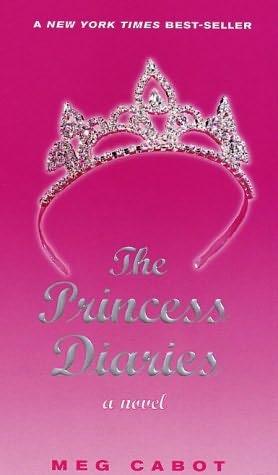
The authors Kaavya Viswanathan plagiarized were Megan F. McCafferty, Meg Cabot, Sophie Kinsella, and maybe Salman Rushdie. With the exception of Rushdie, where the plagiarism was also the least clear, Viswanathan plagiarized well known, successful chick-lit / YA authors.


Chick-lit authors and fans took offense at Egan's description of the genre (or, really, the parts plagiarized) as "very derivative, banal stuff" and bloggers suggested that Egan was guilty of  "girl-on-girl crime" and called for an apology. ( As for the three women themselves, Cabot, posted on her Facebook wall "I'm certain Jennifer Egan didn't mean to be rude." McCafferty was a lot more angry and also received an apology. I don't see anything from Kinsella, did I miss it? ).

Here's the thing: the genre is derivative and banal. Sometimes an author's work is even derived of her own previous books. I spent sometime in a bookstore looking at the backs of Kinsella's Shopaholic books (which is a different series than the book that was plagiarized from), and each one of them had the same book summary: Becky shops a lot, Becky is in trouble because of shopping (financially and romantically) Becky's troubles are resolved and deferred. Becky lives a glamorous life full of hot men (or man, she's loyal to her husband once they marry), cute shoes, gossip, and occasional career.

I've read books by each of these three authors. When I was in 12th grade, my English teacher asked me if there were any books that I was secretive about reading, ones that I didn't want to tell anyone else I was reading. I don't think she was asking me about books I was embarrassed about, but right now that's what I think of. I am embarrassed to admit that I have read these books because I believe in the power and importance of Literature, and I don't think those books are Literature (the pretentious capitalized L is intentional).

My English teacher's question came in the form of a question written in the margins of my final high school English paper. The paper prompt was "what is literature." My answer was "a work of writing that makes the reader feel something." Now, years later, I would change that to "makes the reader feel something that lasts beyond the time it takes to read the work itself or makes the reader re-appreciate the power of language." The second part allows for some of the post-modernist writers to be included as part of Literature and the addendum to the first part is reflective of my belief that not everything that is written is Literature. I write every day. Nothing I write for work is literature. It's written to inform and nothing else. Writing that entertains--even if it makes the reader laugh or cry--but leaves little emotion once the act of reading is completed falls into the same category.

I recognize that my answer is somewhat subjective; maybe there are people who read the works of McCafferty,  Cabot, and  Kinsella and find themselves marveling at the books weeks after the reading is complete. But for me--and clearly for Egan as well--these books fall short of being Literature.

They certainly fill a niche; the authors are wildly successful, and deserve to be. But the books are not memorable. They don't linger. There were no sentences that made me marvel at the possibilities embedded in the English language. At best, they are brain candy, light, entertaining fluff that fills the time well enough while being read but leaves nothing lasting.

Click the arrows or here to read the rest of this post.
The Washington Post, which prides itself on being a local paper, 
lead with the hostage story and teased the Middle East talks. 
The Washington Times--which is a conservative paper which describes 
itself as "America's Paper" (which I take to mean it has a national focus)
--lead with the Middle East talks and teased the hostage story. 
Today, a  man took hostages at the Discovery Channel after entering the building armed with guns, explosives, and a manifesto.

He was demanding that the channel promote radical solutions to environmental problems including, but not limited to, forced sterilization.


But you don't have to take my word for it, you can read the two-page manifesto at the Washington Post's website.


Almost exactly 15 years ago, the Post published another manifesto: the Unabomber's.


Sharing the costs with the New York Times, the Post printed the 50-page manifesto in a special section, but only after months of deliberating over the decision: it was received by the papers in June and not published until December.


Part of the reason for the papers' reticence was that it was directly giving into the Unabomber's demands for publication; Ted Kaczynski said he would stop the bombings if his manifesto was published. Part of it was surely cost. Part of the decision to publish was that an FBI hope that it would help someone recognize the writing and identify the Unabomber


But I have to wonder if the papers would have waited so long to publish, if they received the manifesto today. For one thing, it could have been printed online for free-- though I imagine that Kaczynski would not have been happy with that option, what with being so anti-technology. Also, and more cynically, it would have driven a lot of web traffic to the site, in fact, even in the 90's, the manifesto was widely disseminated on the Internet, and the case had the web abuzz.


But the Internet is a little different today, there is a need for getting news and information out first, regardless of its true news value. There is also some ethos of letting readers decide if the information should be read and passed along.


In today's hostage situation, there were ultimately no victims: all the hostages got out safely. There were also no demands to print the manifesto, so publishing it wasn't giving into demands or cooperating with the FBI. By the time it was published, the hostage situation was almost over.


The questions of how the availability of information on the Internet and of whether or not the status of a case should affect the decision to print came up in the aftermath of Virginia Tech. In fact, the New York Times highlighted that issue by comparing the Virginia Tech gunman, Seung-Hui Cho's video manifestos sent to television stations to the Unabomber's manifesto sent to newspapers:
There is nothing new about criminals trying to manipulate the news media for aggrandizement and gratification. The Zodiac and Son of Sam killers, among others, wrote cryptic messages to newspapers. The Unabomber wrote a large manifesto. And the newspapers, including The New York Times, published them.
The visceral impact of Mr. [Seung-Hui] Cho's video represented an evolution of this virulent strain, updated for a time when any act, no matter how odd or personal, seems destined for immortality on the Web and cycled through 24-hour news channels.
Each of the earlier cases had the plausible suggestion that publishing the message would prevent further harm. Now, Mr. Cho was dead before his videos were shown.


The families of the murdered students at Virginia Tech objected to airing the videos; they felt the decision was insensitive and the videos gave an almost unfettered platform for Cho's views.

In the hostage situation today, there were no victims to object to the printing of the manifesto; the only person who was killed was the gunman himself. This time, the gunman also had his own printing press, in a way: he posted his demands on his own website, http://savetheplanetprotest.com/. Does the fact that the manifesto was already available to the public change what the Post needs to think about before it publishes the document on its own site? It's not easy to get an opinion piece published in the Washington Post, which surely gets more page views than http://savetheplanetprotest.com/. But today, the Post offered up an unedited opinion piece from a guy who used violence to get his opinions heard. Without a crime-stopping aspect, or an obvious newsworthiness (were the quotes in the story not enough?) what was the goal of printing the manifesto? Why print it on your own site instead of just linking to another site? Other than page views, what did it achieve?

The overarching question is, just because the Internet allows newspapers to print whatever they want and as much as they want, should they?

On a similar note, Slate's Jack Schaffer wrote an interesting article about how much coverage newspapers should really give this kind of crime, though he might be being a bit harsh on the Post because it was an important local story as it was happening, and I am sure people checked in wanting updates throughout the day. The Times, it should be noted, did not cover it at all (as far as I can tell).

UPDATE Sept. 2: The Washington Post ran the story front page, complete with photos. There were teasers on the front page to online content, but the online content is housed on postlocal.com. So, even though it was A1, the story's online home indicates that the Post covered it because it was a metro crime story.

Still, people are murdered in D.C. all the time, and I don't think those crimes make A1. Here, no one was hurt except the gunman who was slain by the police. I am sure that the death of the gunnman, James J. Lee, was a tragedy for his family and for people who knew him. But I imagine mothers of children who were killed in crossfire on the streets of D.C. (in areas much less wealthy than Silverspring) wonder why their tragedies did not get as much attention as the death of a man who started out his day with the intention of getting the media to pay attention to him and his views.

The New York Times also ran a story, on page A22 of the New York edition. It was not teased off of the front page.

Seriously?

Wednesday, August 11, 2010 0 comments
I'm still not sure what an editor-at-large does, and I am sure that it varies from magazine to magazine, but these lines  from W's editor-at-large in a New York Observer item are shocking for any editor of a magazine--especially one that calls itself "a little bit edgier" than other big fashion magazines:

"I'm going to buy an iPad! I'm going to buy an iPad! I don't have a computer, so this is a big moment for me," continued Ms. [Lynn]  Hirschberg.
And how does she write her stories now without a computer?
"I don't type them," said Ms. Hirschberg. "I give a handwritten copy to someone who types them, who I pay."

Previous to her new gig, Hirschberg covered Hollywood for the New York Times. Even if glossy magazines are still doing fine in print alone (which I doubt, considering W is looking into iPad apps, and its parent company Conde Nast is not exactly living in the same lap of luxury it used to), any editor should be embarrassed to admit she does not use a computer in this day and age.

A Story Seven Years Too Late?

Tuesday, August 10, 2010 0 comments
I've come here with gripes about the Washington Post's coverage of the internet before, and before I do it again, I just want to say that I absolutely LOVE the articles written by the Post's main "strange stuff on the Internet" beat writer, Monica Hesse. Her writing is engaging, funny, and --most importantly here--relevant.

But Hesse didn't write today's A1 article, and the reporter who did was clearly doing a content-strapped editor a favor.

Here's the headline and lede:

4chan users seize Internet's power for mass disruptions

One morning in June, Google's list of the top global searches began to fill up with random words: "fried chicken," "comic book stores," "gyms." Before anyone could stop it, a racial slur jumped to the No. 1 spot.

And here's graf number five (emphasis mine):

Created seven years ago by a 15-year-old, 4chan is a vast web of anonymous, uncensored message boards. No one's in charge, but the site's users have managed to pull off some of the highest-profile collective actions in the history of the Internet.

As far as I can tell, this is a story about a phenomenon that is seven years old, with a news hook that is two months old.

To make matters worse, Hesse wrote a profile about 4chan and its founder in February 2009 for the same newspaper. Now, there wasn't really a hard news hook then either, but she had a couple of things going for her: she was covering a convention of people who start memes (so at least there was that hook); her writing is light and informative (there's more information in that story than in today's) ;and the story ran in the Style section, which is by definition a place for quirky features.

Today's story, which as far as I can tell adds nothing to the story the Post ran over a year ago, adds nothing new. It's really just a discussion of 4chan gaming Google search trends, which it did months ago.

I get that a lot of Post readers don't know what 4chan is -- I was hanging out with a bunch of 20 somethings the other night and a couple of people in this Internet-savvy bunch didn't know--but running this story on A1, just makes the Post look like a giant luddite.

So why did the story run A1? I have no idea.

But this is the best part. Had the editors and the San Francisco-based technology reporter been a little more in tune with the pulse of the internet, they would have found a news hook.

At about 9 p.m. yesterday, The Smoking Gun, posted a transcript of the 4chan's founder's testimony in the trial of the guy who hacked into Sarah Palin's e-mail during the presidential election. The trial concluded at the end of April, but the testimony had never been seen before.

The Post doesn't mention the transcript at all.

Dr. Seuss Invented The iPod

Sunday, August 1, 2010 0 comments
The other day, I watched The 5,000 Fingers of Dr. T, which is Dr. Seuss' first and only feature film. It a strange dream sequence complete with childhood nightmares, Seussian sets, villains, fantasy, and very strange musical numbers. A good portion of the way through, the lead kid steals this from a prison guard:


That thing he's holding is allegedly a hearing aid, but it certainly looks like a first generation, sparkly Apple product. The ear piece even looks like a giant Apple earbud. And this is in 1953 (which is incredibly clear from the endless references to atomic bombs).
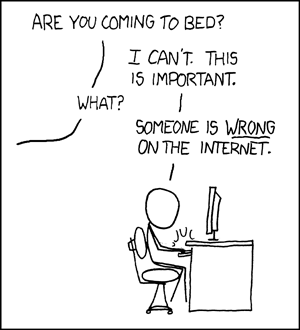
Comic via xkcd.  I know that this is a serious topic,
but I couldn't think of a better way to illustrate this post.
Back in March, the CEO of Tribune Company banned the word "allegedly" from on-air broadcasts at the Tribune-owned web station. It was among 119 words banned from the air because they were not conversational enough. The list is head-scratching-inducing, but "allegedly" stands out as problematic because it is shorthand for "this is not a fact". This person is not yet charged with a crime." It's an important word both for legal reasons and for ensuring that journalists don't skimp on the truth.

It's likely that it often becomes a dangerous shortcut as a reporter runs with a sexy story and the details are enough that readers stop seeing the "allegedly" and just assume the person in question actually committed the crime. But it's something.

I don't know what the New York Times' policy is on the word, but it certainly could have been used more liberally in their coverage of a fire on Staten Island. Last Thursday, a fire in Staten Island killed a family--two sons, two daughters, and  a mother. Investigators quickly determined that the victims were murdered: some of them had their throats slit, and the fire was set intentionally.

They also said that they thought that one of the sons, a 14 year old, was the murderer. That (likely false) theory emerged only hours after the fire.

But now it seems likely the investigators were wrong. Autopsies show the boy died may have died from his slit throat before the fire was started. Investigators are now focused on the mother, while not ruling out the boy's involvement.

The first story that the New York Times wrote liberally relied on variations of the phrase "investigators said" but the reporters also had already drawn the lines between good and evil.

As a single mother in a terrible job market, Leisa Jones had been doing everything she could to hold things together, working part time as a department store security guard during the holidays and, more recently, attending beauty school. Her neighbors said she had made the second-floor apartment on Staten Island where she lived with her four children — two boys and two girls — a place where good manners and good behavior mattered.
On Thursday, after firefighters had picked through the ruins of what they initially believed had been an early-morning fire that killed Ms. Jones and all four children, they uncovered evidence that was even more troubling: Ms. Jones's oldest child...had apparently started the blaze after slitting his sisters' throats.

Those first two grafs are hard to walk back from (which is why I substituted the boy's name for an ellipses). They paint the story of a mother was just a hard working single mother, the hero of everyday life, and of a son who killed his family. "Apparently" does not begin to convey the shakiness of what may end up being a completely false narrative.

The initial story was followed up with a story based on interviews with people who knew the family: the boy had a psychological assessment that recommended he switch schools (though why is unclear), a history of assault, had been bullied, and had been seen lighting paper on fire. If it seems like a leap to say that these were warning signs of homicide on this magnitude, it's because it is.

But that didn't stop the Times from jumping into full-on speculation on the same day:
In front of his home and at a Staten Island pool, he had apparently been lighting fires, flashes of heat and light that spoke, it turned out, of something more than just a fascination with flames. Inside, he burned.

The heat of that rage consumed the 14-year-old boy and left in its place, it would seem, an all-too-mature murderer.
If there's any place "allegedly" should have appeared so far, it should have been in every sentence of this story. The "it would seem" can refer to "all-too-mature" so there's nothing to say that this boy's guilt is not a given. Never mind that the writer has stated "inside, he burned" as fact.  And the boy isn't even alive to contest it.

Two days later, the Times ran this headline: Autopsies Suggest Mother, Not Son, Was Killer in Staten Island Case. The next day  the writer of a the speculation column wrote a new one saying reporters were too quick to latch on to the story. But the damage might be already done.

In the age of the Internet the allegations are there for all to see. Forever. A person could follow an outdated link and never see the new stories.

A paper cannot force a reader to read all the follow up stories, but there are ways to ensure that a reader who wanders onto the old and now outdated article knows that the boy was not a frightening murderer, and that the mother allegedly killed her family. I'm not advocating for removing the stories. They absolutely should remain on the site. But the Times has the technology to update the old stories, and they should do so. The first column only links to other stories that implicate the boy; it does not link to the back-tracking column.

As it stands, the original story does not even have a link to the updated stories. The "related" articles on the bottom are all about older fires and murders. There is no "Times Topic" page about the fire. There is no "read complete coverage here."

That's the least that they could do. If I were the editor I would go even further and offer the links to the updated story in an editor's note at the top, which notes that investigators are  no longer sure  that the 14-year-old boy killed his family.

The Times is not violating any newspaper ethics. The paper ran the story as it believed to be true and then ran follow up stories correcting the record. The Times has run editors notes before when a source lied. But this time, the unnamed firefighters and investigators implicating a dead boy didn't lie, they just made a mistake. So technically, no correction or note is needed.

But the rules of what to correct when might be based on an assumption that a reader will always end up at the most recent story. That's true if a person is picking up a paper every day. It's not true if a reader consumes news by way of social media and following links. It's not even true if you use the Times' own search engine. A search for "Staten Island" brings up the original story implicating the boy before the newer stories (though searching for "Staten Island fire" brings up the headline "Doubts Emerge About Teenager's Role in S.I. Fire" first).

The investigators are still not ruling out the boy's involvement in the crime. But  an editor's note could establish that his guilt has been called into question, and things are not as clear as the article made it seem.

A while back, I marveled at an iPad magazine that was constantly updated with the most recent data. I said that I expected the way that news was saved would change and that readers could expect that old coverage would remain up-to-date. I can't think of a better way to use that technology than to clear a person's name of a crime.

Especially a  boy who cannot clear his own name.
gregpacker_small.jpg?w=450The little bonus text  at the bottom of yesterday's post, might deserve a post on its own. Here are a few disjointed thoughts.

Greg Packer is already camping out for the iPhone 4, which does not arrive in stores until June 24. BUT this time,  the guy who made himself famous by being first in line for almost everything and for offering man-on-the-street comments for almost everything else, is getting paid to sit in line. Gazelle, a company that buys used electronics has offered him all sorts of support in the form of food, camping gear, and clothes as well as $250 a day, totaling $1000. As far as I can tell this is the first time he's been paid for this kind of thing.

But before he was getting paid an  Columbia News Wire included a quote from a pop culture expert trying to explain Packer's desire to be first in line:

When told of the lengths Packer has gone to to be at major events and meet celebrities, Robert Thompson, a Syracuse University professor of pop culture, said Packer has turned a passion into an art form.
"If you're totally obsessed with Shakespeare and James Joyce and go to the ends of the earth researching them, we call you an English professor," Thompson said. "This guy has chosen his body of art to consume, it just so happens he can't make a living off of it. The only fundamental difference is he doesn't have tenure."

I've been curious about how the Internet has changed the way Packer is quoted. On the one hand, it's easier to find out that he's a serial quote-provider. Older articles and memos about Packer cite Nexis searches-- a database only available to institutions willing to pay for the service-- but now anyone can stick Packer's name into Google or Wikipedia, and find out that he's not so average after all. On the other hand, the advent of issue specific websites means that editors might not recognize the Packer waiting in line for a gadget as the same guy who cheers for the winning baseball teams.

That's obviously no excuse for the Times quoting him in 2008, when a search through their own archives would have revealed that the Packer is described as "ubiquitous" and Packer had been the topic of a New York Times profile. But it might be a fair excuse for a niche blog.

Still, in the end, I think that those blogs should take the extra two minutes to google Packer. This is different than googling every name you get for a man on the street comment. This is a guy who is first in line; wouldn't you want to know if his fanboy-ism is real?


(Click here to read the whole post, including choice quotes from Packer).
I'm not really a broadcast news kind of person; I read the newspaper--some on print and some online-- and I listen to NPR. But every once and a while I end up watching the 11 o'clock local news. One of those once-in-a-whiles was the night before the nuclear summit. 

I was watching a television show, and the teasers for  the news kept repeating "How will road closings for the nuclear summit affect your morning commute? Find out at 11."

"Excellent," I thought, as I listened to a stream of motorcades go past the window, "I would love to know if it will affect my morning commute."

So, I stayed by the television to find out. I didn't even get a map of road closures. I got man on the street interviews with person after person who got to tell the television audience how they thought the road closures would affect their own personal commutes.

 First of all, viewers were not informed of where these random people lived or worked so there was no way to draw connections from their experiences to my own. Second of all, these interviews were not live; they were filmed before the road closures began, so the men and women being interviewed were guessing. Hello random person I don't know why YES I want to know whether you think it's annoying that the roads are closed. Oh, wait. I don't. I certainly don't want your inexpert opinions on whether the road closures are necessary in place of actual information about what the road closures are and how they will affect my morning.

In the end, I logged onto WPost.com and found a map there.

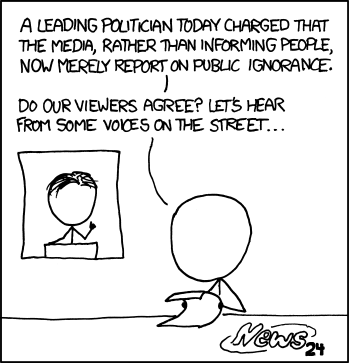
Anyway, this is all old news. I had actually forgotten about this particular annoyance until I came across this xkcd comic:


The hover text on the comic is equally delightful: 

News networks giving a greater voice to viewers because the social web is so popular are like a chef on the Titanic who,  seeing the looming iceberg and fleeing customers, figures ice is the future and starts making snow cones. 
Comparing any news source to the Titanic makes me gloomy, but I certainly agree with the sentiment.

Bonus: Here is an interview with  a guy who  basically makes it his job to get quoted as a man-on-the-street as often as possible.  Most recently, he was first in line to get the iPad, and all sorts of news outlets and blogs dutifully reported it, though many have caught on to his antics. Back in 2003, the AP warned reporters about quoting him.

Depression Kills

Thursday, June 17, 2010 0 comments
thumb_581_20100614200515_25793_327809785325_298590755325_3737399_8302106_n.jpg

A friend of mine lost her brother to suicide this week.

If you are feeling suicidal or depressed, please ask for help: e-mail a friend, call a family member, call a crisis hotline.

If you know someone who might be struggling, reach out or pass on this number.
I don't actually use Twitter. I had an empty account that I set up back in 2007 when I was writing an article about presidential candidates using new-ish technology. (Guess which one was using Twitter? Fred Thompson! He actually has gotten better at it since the campaign, when his account was just a list of events he was attending). My account was never used, used a pseudonymous handle, and had hundreds of spam followers. I closed it years later when I remembered that it existed at all. I now have another one under my real name, which is private and empty while I figure out what actually do it with it.

My confusion about Twitter is, in some ways, like my confusion about the iPad. I understand what to do with it and how to do it, but I don't understand the point. But for Twitter the problem is also related to my work's pretty strict policy about social media that can be traced back to the publication. So, while my Gchat status messages are often witty (or so I'm told), I'm not keen to broadcast them into the ether of the Internet on a site where I would need to follow professional contacts as well as friends. So for now, I'm solely a consumer of tweets.

Which brings me to my real problem with Twitter: I sound like an idiot when I talk about it. The other day, I was complaining to a friend about a tweet that had offered misleading information.  I stopped my self half way through the sentence, because using the words "tweeted" "hashtag" and "handle" and "tweet" in one sentence makes me sound like I am using some middle school code, not talking about actual media that is being archived by the Library of Congress.

And by the way, the vocabulary for Facebook is not much better. Come to think of it,  the verb "to blog" is stupid-sounding too.

So, yes, I am all for Slate's campaign to develop a new vocabulary  even though I suspect it's too late to change very much. (Also, I plan on never using phrases like twitterverse or tweeple. Yeesh).

Image from the Twitter Status Generator.

Maybe Ignorance Is Bliss

Thursday, June 10, 2010 3 comments
There are a lot of things to complain about with Glee. The music is great, but the plots can be sloppy bordering on offensive. 

I seem to be more or less on my own in my level of discomfort in the blackmail plot with Sue and the principal, but catching a Shakespeare reference in the season finale of Glee did not help much:
"One last chit, Figgy, give the glee club another year, and I won't mention us making the beast with two backs again."
I'm willing to bet that the writers did not know that "the beast with two backs" is from Othello. But I did; I am obsessed with Othello.  My thesis for my BA was titled "'All That Is Spoke Is Marred' – The Transformation of Othello As Seen Through Speech."

So, I knew that "a beast with two backs" is part of a list of racially-charged animal metaphors that Iago uses to describe Desdemona sleeping with Othello. And when I heard it here, in describing what the creators of Glee clearly see as a race as well as infidelity issue, I cringed a little. (Emphasis mine).

IAGO
'Zounds, sir, you're robb'd; for shame, put on
your gown;
Your heart is burst, you have lost half your soul;
Even now, now, very now, an old black ram
Is topping your white ewe.
Arise, arise;
Awake the snorting citizens with the bell,
Or else the devil will make a grandsire of you:
Arise, I say....

BRABANTIO
What tell'st thou me of robbing? this is Venice;
My house is not a grange....

IAGO
'Zounds, sir, you are one of those that will not
serve God, if the devil bid you. Because we come to
do you service and you think we are ruffians, you'll
have your daughter covered with a Barbary horse;

you'll have your nephews neigh to you; you'll have
coursers for cousins and gennets for germans.

BRABANTIO
What profane wretch art thou?

IAGO
I am one, sir, that comes to tell you your daughter
and the Moor are now making the beast with two backs.
It should be noted that this dialogue also produces an exchange that should be printed on DC Shakespeare shirts:

BRABANTIO
Thou art a villain.

IAGO
You are--a senator.

Feminist Kaleidoscope

Thursday, June 3, 2010 0 comments
This is an essay, apropos of nothing, that I originally wrote for another blog. I'm reprinting it here, because more than a year after writing it I am still proud of it and still grappling with these issues. 


"It's really important to make women in our community less invisible," the chief Rabbi of England, Jonathan Sacks, said at a panel discussion in D.C. in advance of the release of a prayer book with his commentary. A murmur of approval rose from the audience.

"You can see it on the first page of my siddur," he said, referring to the version of the prayer book with his commentary. He has written the first prayer in both the feminine and the masculine grammatical forms. He has included a prayer of thanksgiving for the birth of a girl. He has -- as chief rabbi--fought for aggunot [women whose husbands refuse to give them a divorce] and for strong, religiously acceptable prenuptial agreements, and for communal lay-person leadership roles.

His prayer book still has the line "Blessed are you God for you did not make me a woman." In the American version, there is no commentary on that line. The editor took it out; it was too much apologetics, not enough explanation.

The murmurs continued, and I felt deeply sad. This is what constitutes progress in the religion that I am deeply committed to and deeply believe in: ensuring women can get a divorce (and thus avoiding a lifetime barring on re-marriage that does not ever apply to men), can say prayers with the proper grammatical endings, can be born with thanks. Changes dictated by the men.

Blessed Are You God for you did not make me a woman.

I imagined tiny pieces of glass falling on me from above, my hand bleeding and cut when I try to push on that ceiling from below.

The women say, "Blessed Are You God for making me as you willed."

I am intensely jealous of the women engaging in great discussions about what it means to be a feminist in the 21st century. I look at my feminism through a kaleidoscope. My extra lens of religion seems to make articulating my feminism exponentially more difficult.
In general, I'd rather curl up with an old school book or newspaper than read long texts on a computer or other gadget. But I'm not a luddite; I know that technology has to be the savior of my beloved newspaper, and to a lesser extent books.

So--even though I still don't really understand the iPad--I read Gizmodo's review of Popular Mechanics' iPad edition with real interest.

Gizmodo was less than impressed with Wired's attempt, basically noting that it just looked like a printed magazine on a screen with some extra special effects. I had a hard time figuring out what exactly one would expect to see in an iPad magazine that brought something totally new to the table.

But when I read these lines in the Popular Mechanics review, I  began to understand.

Second, and key to keeping the app feeling alive and relevant, it pulls in new info, so the app doesn't become a fossil once you're done with the issue. The mini-app-within-an-app—a living infographic, if you will—that they demoed for me charted seismological data in the US, not only historically, but also using the most recent 7 days of earthquake data from the USGS. Which is really savvy—the mag retains value after you're done reading the issue.

The iPad version, which Gizmodo is quick to note is still "incrementally reformatting the magazine, instead of reinventing it" does acknowledge the strange thing about print publications: they are out of date before they hit the stands. Electronic versions of magazines never have to be out of date.

Stating it like that seems overly obvious and incredible old news. News online is always more up-to-date than news in print. That's part of the problem, and people have been talking about that for years. But magazines have a particularly hard time of it because they go to print so early.

It was particularly obvious in the wake of the  September 11 attacks, when newspapers and magazines apologized for having to distribute content written for a September 10 kind of reality. (Below are the Sept. 17 and Sept 24 issues of the New Yorker as an illustration of that lag).
Overheard on an airplane in D.C.:

Flight Attendant to boarding passenger: I like your dress.

Boarding Passenger (who appears to be in her 20s and is wearing a knee-legnth, pink, sleeveless dress with detailing around the hem): Thank you.

Flight Attendant: It's very Sex and The City.

Boarding Passenger: It's very TJ Maxx.

Flight Attendant: It's very Carrie Bradshaw.

Passenger continues walking. I wonder if she felt complimented by the somewhat strange exchange and how much she sees herself in Bradshaw (projecting my own life onto this stranger I would guess 'not at all'.)
They were balanced precariously in too-full bags; their green leaves sticking out of the top. I walk past a construction site and they thwip thwip against a fence.

Crossing the street, I feel something brush my ankle and one of my leeks is on the ground. I double back, and as I turn back around the other one falls. I'm out of time for retrieving it. Standing on the sidewalk, I watch two cars miss the leaves before the third drives over them. The leek still looks intact.

Two days later, I think it's gone. Crossing the street, I notice  a web of white crushed into the street. As if the leek had silk hidden inside.
Does anyone else get the sense that Mark Zuckerberg fills in Mad Libs to generate his apology letters? (Here, here, and here).

The most recent one doesn't actually apologize, but the game is still there. Here's samples from today, 2007, and 2006 respectively:
  • The biggest message we have heard recently is that people want easier control over their information. Simply put, many of you thought our controls were too complex. 
  • Beacon would give people an easy and controlled way to share more of that information with their friends. ...But we missed the right balance.
  • We did this to make sure you could share information with the people you care about. This is the same reason we have built extensive privacy settings — to give you even more control over who you share your information with.Somehow we missed this point with News Feed and Mini-Feed and we didn't build in the proper privacy controls right away.
So when exactly were they hearing something other than people wanting more control over privacy settings?


Remember when Facebook looked like that image above?

Search This Blog

Contact Me

Written Pyramids is a blog written by a journalist living and working in Washington D.C.

I have left my real name off of the blog so as not to imply that the blog is somehow linked with the journalism I get paid to do. (Still, I never write about my beat on this blog, and rarely express opinions about the day's news regardless of its relationship to my beat).

I would love to hear from you. If you want to contact me directly rather than leaving a comment here, I can be reached at WrittenPyramids@gmail.com.

Blog Archive

Books pyramid image originally from the British website, Explore Writing.